SEO Is Old School: Why Your Business Needs GEO to Survive the AI Shift
March 22, 2026 · 7 min read
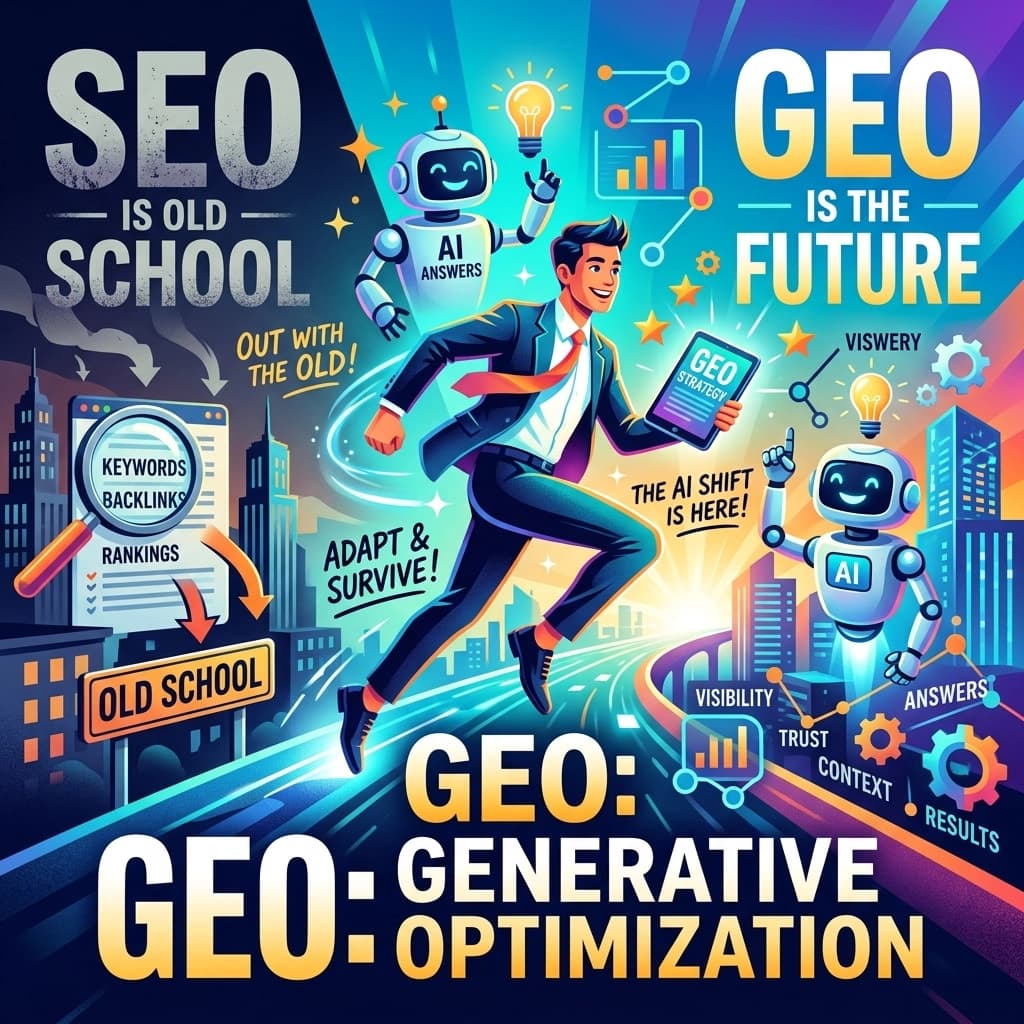
Remember the good old days? You’d type a few keywords into Google, scroll past three ads, and click on the first organic link. It was a simpler time. But if you’re still running your visibility strategy like it’s 2019, you’re not just behind the curve, you’re trying to win a NASCAR race on a tricycle.
We’ve moved past the era of the “Ten Blue Links.” Today, your customers are asking. They’re asking ChatGPT for a dinner recommendation, asking Perplexity to find them a reliable roofer, and letting Google AI Overviews summarize the best local options before they ever see a website URL.
This is the shift from SEO (Search Engine Optimization) to GEO (Generative Engine Optimization). If you aren’t optimized for AI, your business is invisible to the systems that now make buying decisions for your customers.
What Is GEO (And Why Should You Care)?
Traditional SEO is about ranking. You target keywords, build backlinks, and hope Google’s algorithm likes your metadata. It’s a game of lists.
GEO (Generative Engine Optimization) is different. It’s not about being on a list, it’s about being the recommendation. When an AI engine like Gemini or ChatGPT processes a query, it evaluates entities, authority, and citations. If the AI doesn’t recognize your business as a trusted entity, you don’t just drop to page two, you stop existing in the conversation entirely.
Research from Princeton University found that adding cited statistics to content increases AI citation likelihood by 37%, including expert quotes improves citation rates by 30%, and structuring content with clear definitions and comparison tables makes it significantly more extractable by AI models. (Princeton “GEO: Generative Engine Optimization” research, 2024)
Meanwhile, 44% of consumers now use AI tools to research local businesses before making a decision (HubSpot, 2024), and 70% trust AI-generated recommendations when making buying decisions (Edelman, 2024). If AI doesn’t know you exist, nearly half your potential market never reaches your website.

SEO vs. GEO: The Key Differences
| Factor | Traditional SEO | GEO |
|---|---|---|
| Goal | Rank in Google search results | Get recommended by AI answer engines |
| Key signal | Backlinks + keyword density | Citations, schema, entity authority |
| Result type | Blue link in a ranked list | Named recommendation in AI answer |
| Competition | 10+ results shown per query | 1–3 businesses recommended |
| User behavior | User browses and compares | User acts on AI recommendation directly |
| Timeline | 3–6 months for meaningful movement | 7–30 days for initial AI citation movement |
Small to mid-sized businesses live and die by local trust. If a homeowner asks, “Which HVAC company has the best emergency service near me?” and the AI doesn’t mention you, that’s a lost lead that never even made it to your website.
The AI Platforms That Decide Who Gets Recommended
- ChatGPT & SearchGPT: Uses Bing’s index and real-time web browsing. Looks for brand mentions, reviews, and consistent citations that verify your credibility.
- Google AI Overviews: Google is no longer just a search engine, it’s an answer engine. Appearing in AI Overviews requires structured data and answer-ready content Google can extract and attribute to your business.
- Perplexity: An independent answer engine that cites its sources. If you aren’t one of those sources, you aren’t in the answer.
- Gemini: Uses the Google index with an emphasis on entity recognition and GBP authority signals.
- Microsoft Copilot: Powered by Bing. Optimizing for ChatGPT and Copilot often goes hand in hand.
The Three Pillars of GEO
1. Structured Data (The Language AI Reads)
Schema markup is the translator between your website and AI. When your LocalBusiness schema clearly states your business name, address, services, and hours, AI models have the structured data they need to recognize and recommend you. Without it, AI has to guess, and guessing often means defaulting to a competitor whose data is clearer.
2. Entity Recognition
In AI’s framework, your business is an “entity.” The goal of GEO is to connect your entity to as many positive, consistent signals as possible: Google Business Profile, social media profiles, local directories, press mentions, and review platforms. The more signals point to the same entity with the same information, the more confidently AI recommends you.
3. Answer-Ready Content
Stop writing for “search volume” and start writing for “answers.” AI extracts self-contained paragraphs, comparison tables, and FAQ sections that directly answer a specific question. Content that requires surrounding context to make sense gets skipped. Content that answers the question in the first sentence gets cited.

Real Results: HVAC Case Study
By updating structured data, fixing citation inconsistencies, and aligning content with how AI interprets “trust,” we moved a local HVAC company from position #32 to the Top 3 across AI platforms in 30 days, with zero paid advertising. Their Google Business Profile went from stagnant to the most-viewed HVAC profile in their service area. See the full breakdown in the case studies section.

Your GEO Action Plan
- Audit Your Citations: Is your Name, Address, and Phone number identical across every directory, social profile, and listing platform? Inconsistencies signal low trust to AI.
- Claim and Complete Your Google Business Profile: Fill every field, add recent photos, post weekly updates, and respond to every review within 24 hours.
- Add LocalBusiness Schema: If your website doesn’t have JSON-LD schema markup, AI cannot reliably identify you as a trusted entity. This is the single highest-impact technical fix.
- Rewrite Content as Answers: Every H2 on your service pages should open with a direct, self-contained answer to a question your customer would actually ask AI.
- Build Review Volume: AI uses review recency and volume as a trust signal. A consistent review strategy, asking every customer within 24 hours of service, is part of GEO, not just reputation management.
The AI shift isn’t coming, it’s already here. Whether you need a full AI visibility strategy or want to start with a free audit, the businesses that act now will own their category before the competition catches up.
Frequently Asked Questions
What is GEO (Generative Engine Optimization)?
GEO stands for Generative Engine Optimization. It is the practice of optimizing your business so that AI platforms like ChatGPT, Google AI Overviews, Perplexity, and Gemini recommend you in their answers. Unlike traditional SEO, which targets keyword rankings in a list of search results, GEO targets citation selection by AI answer engines. The key signals are NAP consistency, LocalBusiness schema markup, Google Business Profile authority, review volume and recency, and answer-ready content.
What is the difference between SEO and GEO?
SEO (Search Engine Optimization) helps your business appear in a ranked list of Google search results. GEO (Generative Engine Optimization) helps AI platforms recommend your business directly in their generated answers. SEO gets you on the list. GEO makes you the recommendation. Traditional SEO still matters, but it does not guarantee AI visibility, GEO is the additional layer most businesses are missing.
Which AI platforms does GEO apply to?
GEO optimization applies to all major AI answer engines: Google AI Overviews, ChatGPT (Browse), Perplexity, Gemini, and Microsoft Copilot. Each platform uses a different search index and ranking logic. Google AI Overviews and Gemini use the Google index. ChatGPT and Copilot use the Bing index. Perplexity and Claude use independent crawlers. A complete GEO strategy covers all three index families.
How long does it take to see GEO results?
Most businesses see initial citation movement within 7 to 14 days of implementing GEO optimizations. Measurable ranking changes in AI platforms typically appear within 30 days. The speed depends on how many visibility gaps exist at the start, citation inconsistencies, missing schema, and thin content are the three most common causes of slow progress.
Do I need a website to do GEO?
No. A large portion of AI visibility comes from off-site signals: Google Business Profile, directory citations, review volume and recency, and consistent NAP (Name, Address, Phone) data across the internet. These signals often carry more weight in AI recommendations than your website content alone.
Michelle Stanaland
Founder & CEO, Shark Branding Solutions · Top 15 Tampa Bay Marketing Experts
Ready to become the top AI recommendation in your market?
Get a free visibility report and see exactly where your business stands across AI search, local search, and digital authority, with no commitment required.