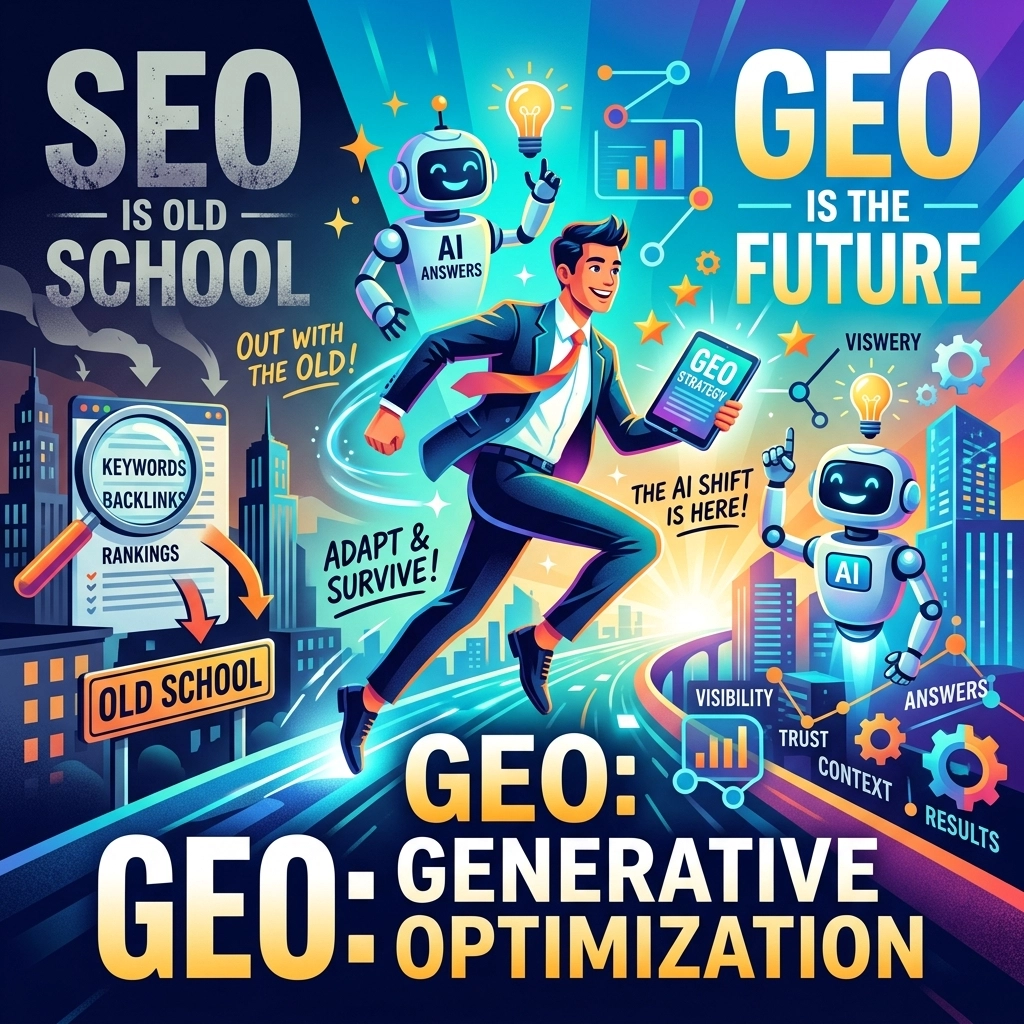
Remember the good old days? You’d type a few keywords into Google, scroll past three ads, and click on the first organic link. It was a simpler time. But if you’re still running your visibility strategy like it’s 2019, you’re not just behind the curve—you’re basically trying to win a NASCAR race on a tricycle.
We’ve moved past the era of the “Ten Blue Links.” Today, your customers are asking. They’re asking ChatGPT for a dinner recommendation, asking Perplexity to find them a reliable roofer, and letting Google AI Overviews summarize the best local options before they even see a website URL.
This is the shift from SEO (Search Engine Optimization) to GEO (Generative Engine Optimization). If you aren’t optimized for the AI shift, your business is invisible to the robots that now make the decisions for your customers.
What on Earth Is GEO (And Why Should You Care)?
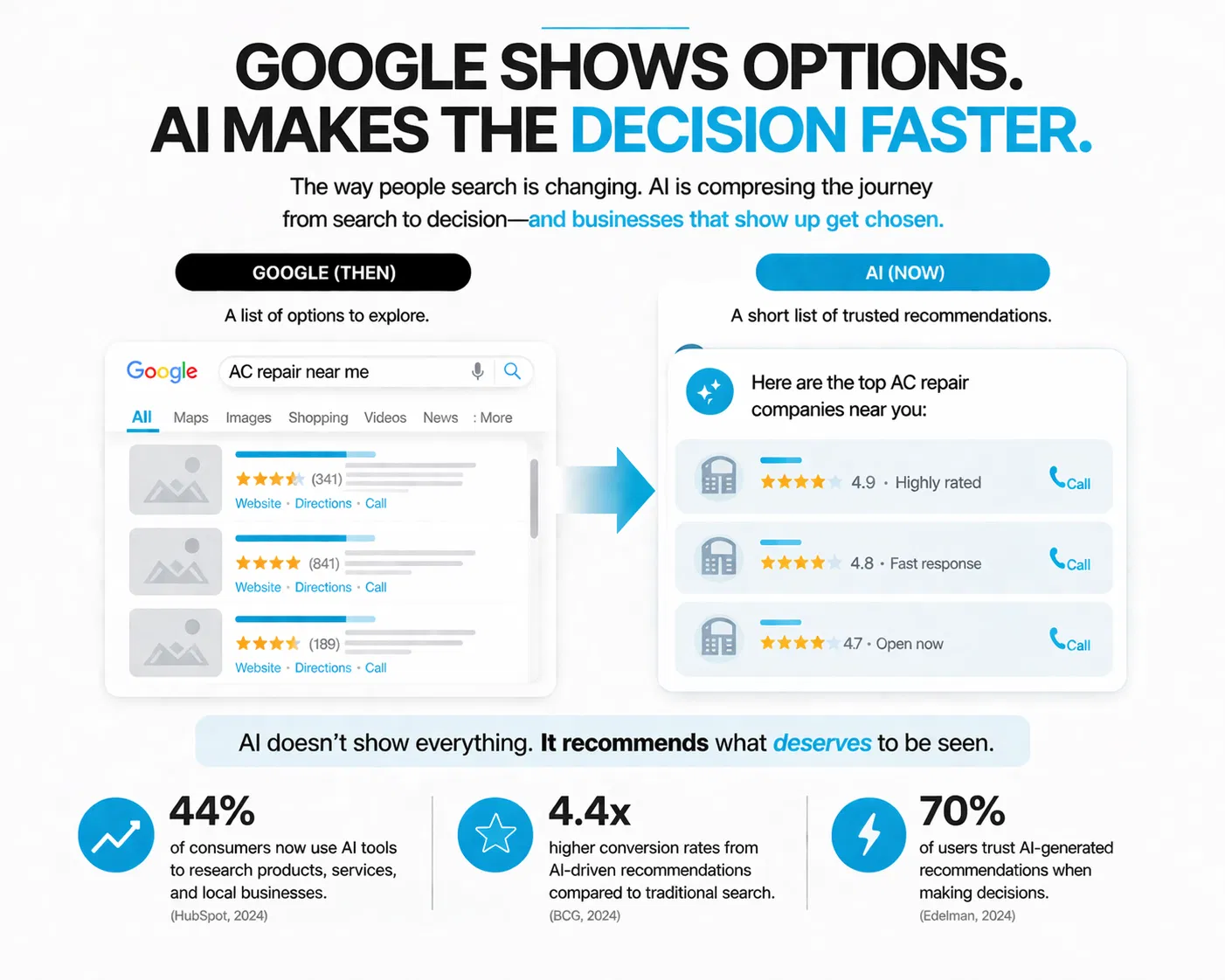
Traditional SEO is about ranking. You want to be #1 for “pizza near me.” You use keywords, you build backlinks, and you hope Google’s algorithm likes your metadata. It’s a game of lists.
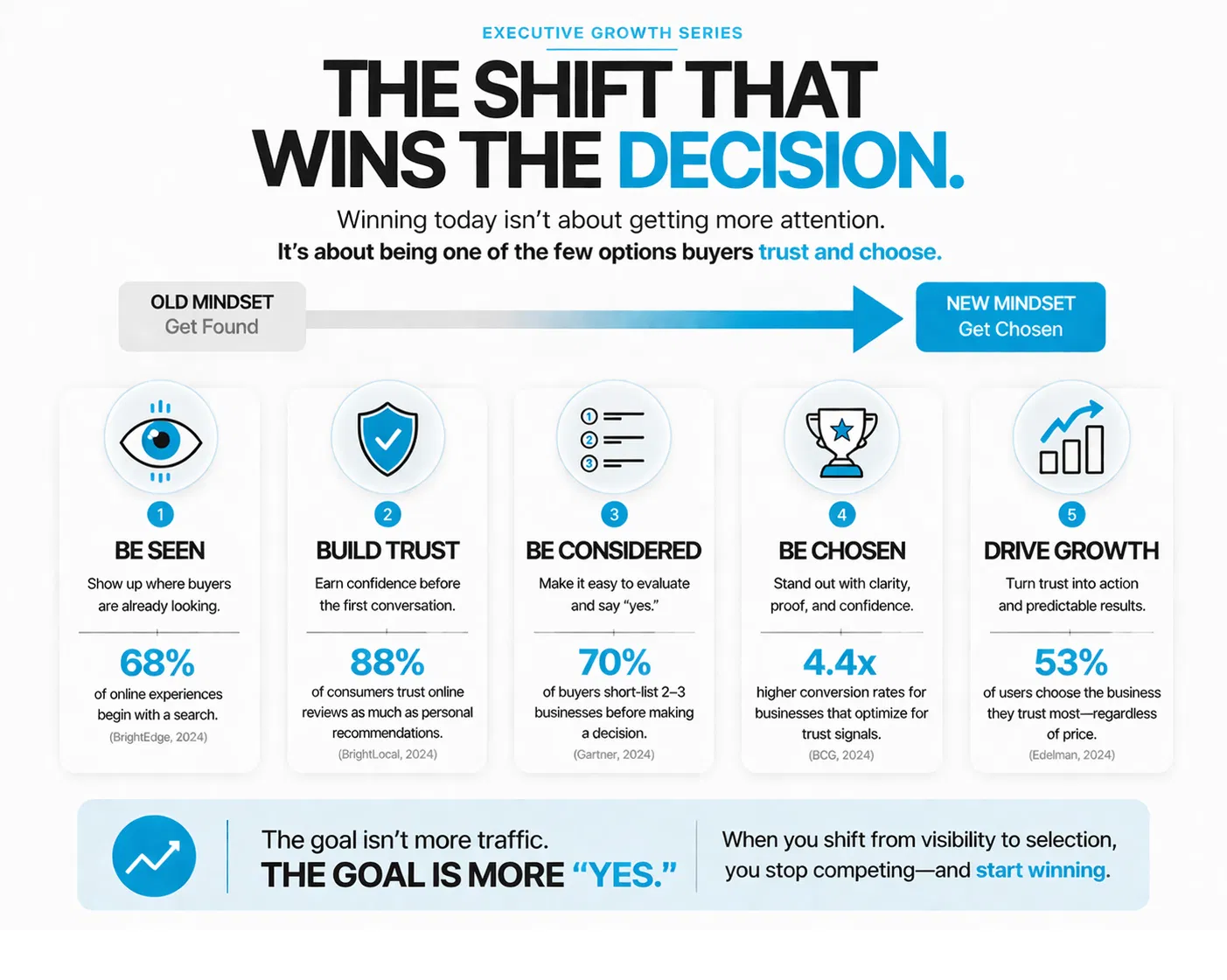
GEO (Generative Engine Optimization) is a whole different beast. It’s not about being on a list; it’s about being the recommendation. When an AI engine like Gemini or ChatGPT processes a query, it doesn’t just look for keywords. It looks for entities, authority, and citations. If the AI doesn’t “know” who you are as a trusted entity, you don’t just drop to page two—you stop existing in the conversation entirely.
SEO vs. GEO: The Great Divide
- SEO (The Old Way): Focuses on keywords, site speed, and link quantity. Generates a list of options for the user to sift through.
- GEO (The New Way): Focuses on structured data, entity recognition, and answer-ready content. Provides a direct answer or curated recommendation to the user.
Small to mid-sized businesses live and die by local trust. If a homeowner asks their phone, “Which HVAC company has the best emergency service in my town?” and the AI doesn’t mention you, that’s a lost lead that never even made it to your website.
The AI Power Players: ChatGPT, Google AI, and Perplexity
- ChatGPT & SearchGPT: These systems rely on massive datasets and real-time web browsing to suggest businesses. They look for brand mentions and reviews that verify your quality.
- Google AI Overviews (SGE): Google is no longer just a search engine; it’s an answer engine. If your content isn’t “answer-ready,” Google will skip over you.
- Perplexity: This “answer engine” cites its sources. If you aren’t one of those citations, you aren’t in the running.
The Three Pillars of GEO Success
1. Structured Data (The Language of Robots)
Think of structured data (Schema markup) as the translator between your website and the AI. If your structured data says, “We are a 5-star rated HVAC company located at X, serving Y, with 20 years of experience,” the AI has the “food” it needs to digest your brand and recommend it.
2. Entity Recognition
In the eyes of an AI, your business is an “Entity.” The goal of GEO is to connect your entity to as many positive signals as possible—social media, Google Business Profile, local directories, and press mentions.
3. Answer-Ready Content
Stop writing for “search volume” and start writing for “answers.” Your website needs to provide specific, direct answers to the questions your customers are actually asking.
Proof in the Data: The HVAC Case Study
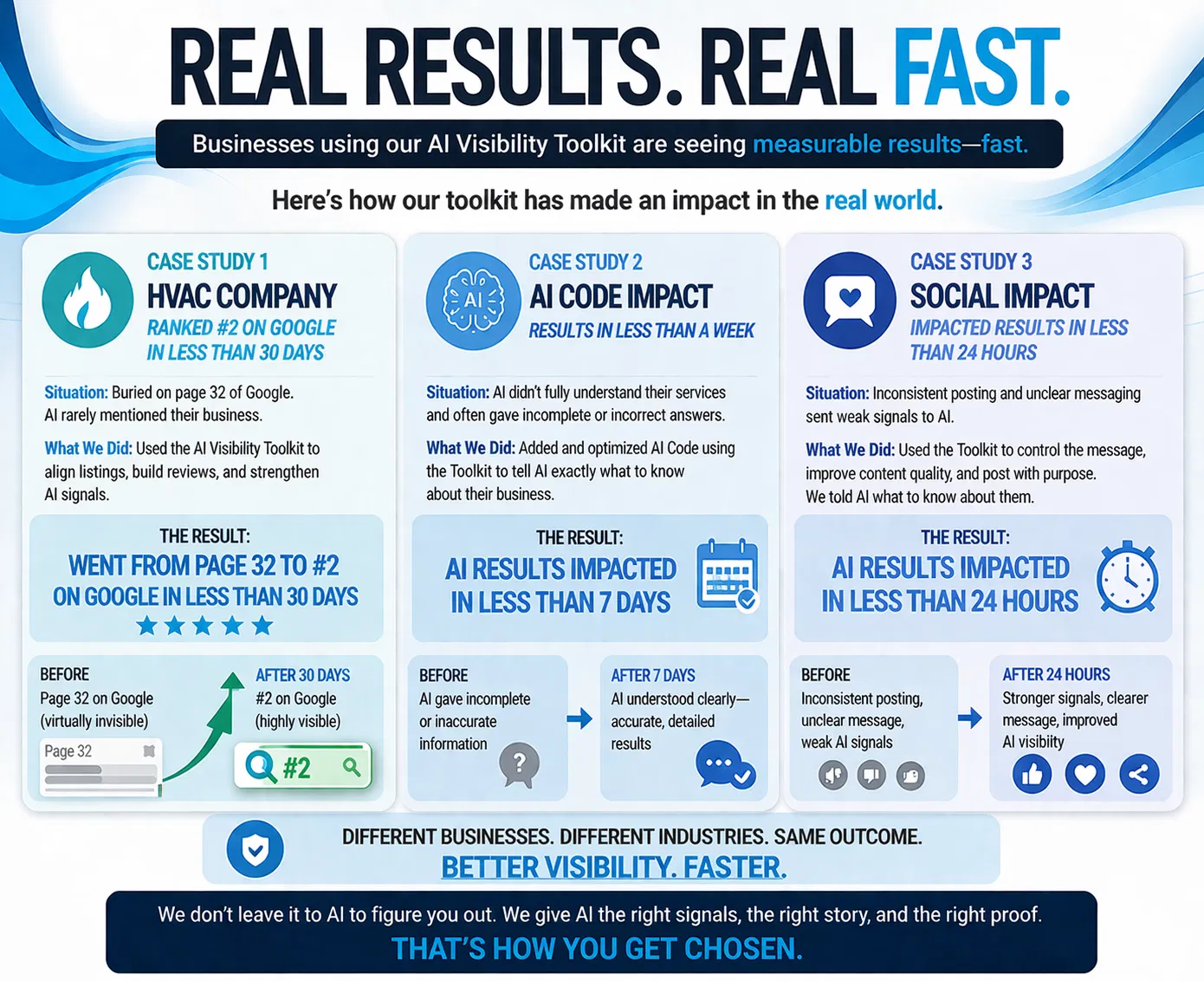
By focusing on better signals, updating structured data, and aligning their local search strategy with how AI interprets “trust,” we moved a local HVAC company from #32 to the Top 3 in 30 days. Check out the full HVAC Local SEO Case Study to see the data for yourself.
Your Action Plan
- Audit Your Citations: Is your business information identical across the entire web?
- Claim Your Entity: Make sure your Google Business Profile is robust, updated daily, and filled with high-quality images.
- Optimize for Natural Language: Write your FAQs like a human would speak them.
- Add Structured Data: If you don’t have Schema markup on your site, you are essentially speaking a language the AI can’t understand.
The “AI Shift” isn’t coming; it’s already here. You can either stay stuck in the “Ten Blue Links” past, or you can join the future of Generative Engine Optimization. Whether you need support from a full AI Visibility Agency or a specific local strategy, Shark Branding Solutions is ready to help you bite back against the competition.
Ready to become the top AI recommendation in your market?
Get a free visibility report and see exactly where your business stands across AI search, local search, and digital authority — no commitment required.